
Demons Are Real
By Ezra

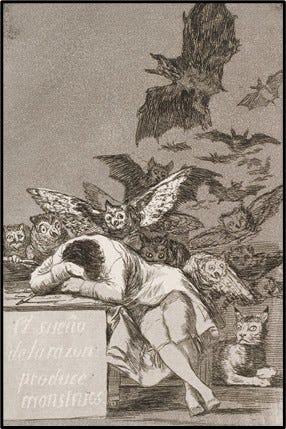
There is an etching by Spanish painter Francisco Goya titled, “El Sueño de la Razón Produce Monstruos”. The textbooks remember it as “The Sleep of Reason Produces Monsters”. Owls rest on a man deep in an exhausted slumber, lying in an ungainly equipoise. As darkness engulfs the rest of their parliament, the noble birds retreat into chthonic shadows; the man’s consciousness seemingly the only thing restraining the birds from a demonic transubstantiation. Understood in this light, the work is of a piece with traditional narratives about the ennobling force of the enlightenment.
But “sueño” also means “dream”. The startling and confronting thing about this alternative translation is in how it reinterprets the relationship between reason and its devils. An excess of rational inquiry, not a deficit, becomes the cauldron from which demons spew. It has always been the dreams of rationality that produce monsters.
To express a belief in demons, more broadly a belief in “enchantment” as a metaphysical reality, has become a shibboleth by which the liberal magisterium has discounted the status of its members. It is a distinguishing belief; even those who hold it are meant to express some internal dismay or disgust at their rational inadequacies. However, even the most spiritually bare must recognise that demons used to exist. Or at the very least people just as intelligent, and just as scientific, as ourselves, were utterly convinced they existed.
“The past was enchanted. It was a world in which the supernatural was natural, where heaven and earth intermingled constantly, where angels and demons were as real as birds and beasts.”
– Carlos Eire
It is difficult, from our vantage, to grasp how ordinary the supernatural was for those early modern scientists. The most peculiar aspect of the documentation of supernatural events in the West is that it peaks only after the birth of skepticism and empirical science. The age of Galileo, Descartes, Newton, and Leibniz was coterminous with the flying witch, the levitating saint, and the devil in corporeal form. In early modernity we see a moment in time in which the seeking rational mind, the scientific mind, found its objects of observation in the impossible and demonic. In an unadulterated seeking of truth, we found monsters.
Of course, the ardent materialist can try to wash their hands of it. Without even parsing the literature, they can insist that these events did not happen, that people did not see what they claimed to see. That these events are impossible.
And of course, they are impossible. No one knew that better than the witnesses themselves. These were not instances of private hallucination, where the mind develops a coherent, fantastical picture for itself. These were public impossibilities, seen against the weight of everyday reality. The observers of supernatural phenomena were perfectly cognisant of the disparity between reality and the flying witch. And yet, they were damn sure that witch was flying.1
But what then are we to make of all this? Did Arthur Conan Doyle, Pierre and Marie Curie, Mary Todd Lincoln, Alfred Russel Wallace, truly encounter spirits at their seances.
I don’t know.
What I do know is this: had you or I lived in early modernity we too would have lived in enchanted times. We too would have known, just as surely as I know the grass under my feet, that demons were real.
But of course, we live now in “disenchanted” times.
Something happened in the transition between early modernity and our own spiritually pallid era. The rational mind, once fascinated with the inexplicable, has turned against it. Here are two stories of how that unfriendly divorce took place.
People used to see demons. Now they don’t. Science sets the rules for what counts as evidence. Studies have to be repeatable, and there are no videos of Saint Gabriel flying through the halls of Yale. It isn’t, then, that science ignored the inexplicable, it explained it.
Here’s another story.
People used to see demons. When science was young and hungry for truth, the inexplicable drew its gaze. The unexplained wasn’t dismissed, it was investigated. Then something changed.
The experiences themselves never disappeared. Step outside the halls of Oxford, Harvard, and The New York Times (or even within them after a few drinks) and you will hear the same parochial tales. Of dead people talking through the firmament of the iPhone. Of UFO abductions qualitatively identical to the visions of Catholic mystics. Of encounters with Mexican demi-demons in a psychedelic haze. Nothing, in the end, that William James or Saint Francis of Assisi would not have recognised.
But science grew tired.
It bristled at questions it couldn’t answer, at mysteries it couldn’t master. Instead of inspecting the intricacies of life it cornered them off. Consciousness? An illusion. The universe’s beginning? Not a real question. Free will, the most obvious fact of human life? A childish fantasy. And spiritual experience? The delusions of an animal mind.
This hermetic seal around questions of life and death produced no answers, but it gave scientific careerists the comfort of certainty. If a real challenge were to emerge, it could be brushed under the rug with the rest of them. The slumber of reason in the modern West didn’t banish monsters, it merely deferred their categorisation.
I tend to think the second story is closer to the truth.
But for the obdurate materialist, I have one more plea. Everything above describes only those forms of enchantment with clear analogues in the early modern past. I myself have never seen a demon. I have not spoken to the dead. I have yet to encounter the mystical phenomena that seemed to pervade my ancestors’ lives. And yet I still feel surrounded by enchantment.
For demons in late modernity live with us in the digital plane, and they speak through living wires. What is the digital plane if not a purely metaphysical beast? A realm without bodies, where unencumbered minds can collide and merge. A strange kind of heaven on earth.
We speak to avatars we can never understand, and yet there is nothing we understand more. Content is conjured up in an ecosystem that no one controls, and yet all must inhabit. And we live at the whim of algorithms that whisper in ancient tongues, shaping our desires and moulding our fears.
And sometimes, in this mesh of living wires, the whispers turn dark. Men sit alone in their rooms and, by some mystical possession, are seized with the spirit of violence. In the place of Mammon and Lucifer, digital demons compel murder through the circuitry of a living god.
We live in enchanted times.
And we should be afraid of the demons that live with us.
For those who want the record in full, Carlos Eire’s book “They Flew” offers a meticulous catalogue of early modern impossibilities and the scientists who saw them.
Nobody should be afraid. Fear is demonic. Fear is not a natural human emotion since it obviously weakens people. Calmness is beneficial.
People should act on their own will rather than a temporary feeling like fear. Even if you think fear has a benefit like helping people not get hurt, that’s slavery. Fear is slavery and compulsion. So ignore it and act immediately.
https://substack.com/@stevenberger/note/c-183757527?r=1nm0v2&utm_source=notes-share-action&utm_medium=web